Introducing the Lumonic MCP: artifacts included

Kevin Hsu
Today the Lumonic MCP is generally available for every Lumonic customer (go to your MCP settings). We're launching this in tandem with the MCP Library: proven prompts and finished artifacts, one per asset class, so you're never staring at a blank chat box.
Connect Claude, ChatGPT, or any MCP-enabled model to your Lumonic account and chat with your portfolio data. Every number in the answer links back to its source document, down to the cell or the exact spot on the page.
What is MCP?
MCP (Model Context Protocol) is the open standard that lets AI assistants read from the systems you already use. The Lumonic MCP server gives your AI of choice read access to your workspace: periodic financials, covenant status, reporting status, and the KPIs you track. It isn't tied to one model. Claude and ChatGPT both work, along with any MCP-enabled client your firm has approved.
It’s been live since early this year, with early adopters across private credit, private equity, and venture capital using it every day.
Inside the library
The first three artifacts release today (by asset class) alongside prompts that have been rigorously tested:
Private credit: a full portfolio review, every borrower on one page from covenant flags to marks, with a simple risk rating built in
Private equity: a valuation workbook using the Lumonic and PitchBook MCPs side by side, includes an EBITDA bridge
Venture capital: a company tear sheet, every metric from ARR to runway
Each artifact contains starter prompts inside. Download one, connect it to your Lumonic account, and every number returned will trace to its source document. If you're a Lumonic customer, reach out and we'll custom tailor them to your firm's brand.
Where did that number come from?
An auditor asks it at quarter-end, the founder asks it in the middle of investment committee, and answering it has always meant digging back through old emails and source files until you find the exact cell the figure came from.
Any AI model will hand you an EBITDA figure or a leverage ratio in seconds, but it does nothing to help you prove one. With the Lumonic MCP, every figure arrives with a traceback link: click it and Lumonic opens the source document at the exact line the number came from, whether that's a compliance certificate or page six of the management accounts.
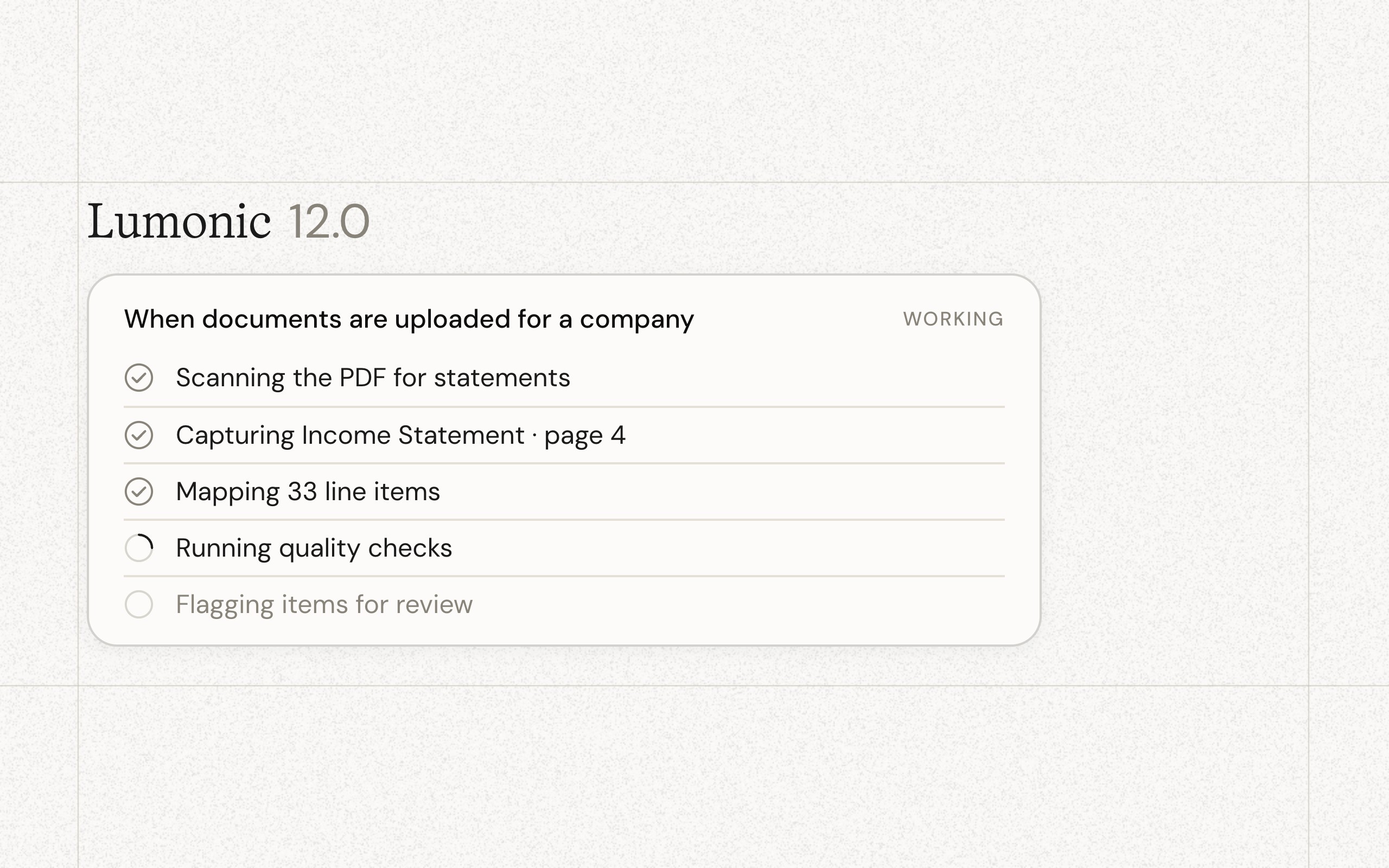
A traceback link is only as good as the data it lands on. MCPs are table stakes; the data layer under them isn't. Ours starts with extraction built for the documents portfolio companies actually send, reviewed by your team before a model ever reads it.
Live formulas in Excel, not pasted numbers
A key difference with the Lumonic MCP: it doesn't just answer in chat, it writes live Lumonic formulas straight into Excel. Most connectors hand you static values, and they're stale the moment they are printed. Ours writes each cell as a formula pulling from Lumonic, so it refreshes when new financials come in and carries the same traceback as the chat answer.
What's next
Over the coming weeks we'll publish how customers actually use it, starting with a CFO who built his firm's reporting workbook in Claude in an afternoon.
We're also collaborating deeper with PitchBook. Lumonic is a PitchBook company, and the two MCP servers already run side by side in the same conversation: your portfolio financials from Lumonic next to live market data from PitchBook. Today's valuation workbook is the first artifact built on both, with more dual-MCP workflows on the way.
The press release, issued with PitchBook, is on Business Wire.
Get started
Everything you need is at lumonic.com/mcp: the full MCP Library, setup for Claude, ChatGPT, or any MCP-enabled client, plus an FAQ and security documentation.
If you're not a customer and want to see it on your own portfolio, get in touch and we'll run a proof of concept on a few of your companies.