Why do analysts calculate different adjusted EBITDA from the same compliance certificate?
Lumonic Team
A credit agreement typically defines adjusted EBITDA in legal text, but analysts must turn that definition into a calculation. Two analysts at the same firm can read the same reporting pack and reach different numbers when they treat an add-back differently. Maker-checker review can catch the discrepancy, but resolving it may require searching prior files and asking colleagues why an item counted.
Same reporting pack, two leverage ratios
In this fictional example, page 4 of a portfolio company's Q2 2026 reporting pack shows an EBITDA reconciliation: $44.1 million of EBITDA as reported, then two management adjustments, $2.9 million of restructuring costs and $1.5 million of pro forma cost savings, for $48.4 million of adjusted EBITDA as submitted. Total debt is $155.0 million. The credit agreement sets a 3.25x maximum total leverage ratio, and the covenant compliance certificate tests against that limit.
Analyst A accepts both adjustments. Their worksheet uses $48.4 million of adjusted EBITDA and divides $155.0 million of total debt by that figure, producing 3.20x. Analyst B accepts the restructuring add-back but excludes the pro forma cost savings. Their worksheet uses $47.0 million of adjusted EBITDA, which produces 3.30x after rounding.
The $1.5 million of pro forma cost savings creates the disagreement. One analyst treats it as a permitted add-back under the credit agreement. The other analyst decides that the savings are projected rather than realized, or fall outside the agreement's cap or time limit, so the amount should stay out. Both worksheets use amounts shown in the reporting pack, but the analysts disagree about whether the agreement permits the cost-savings add-back.
One worksheet passes the covenant test by 0.05x. The other fails it by 0.05x. The worksheets reach opposite conclusions because the analysts apply the agreement's add-back definition differently.
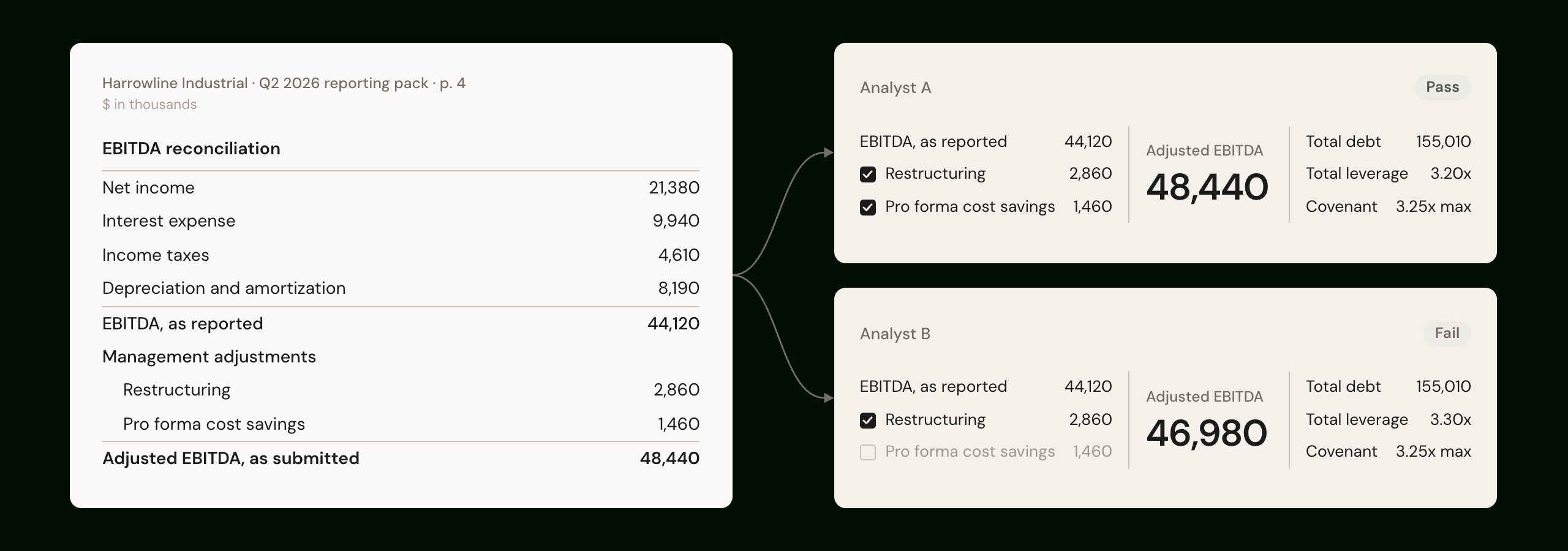
Sample data. Fictional borrower.
Where the two numbers come from
The credit agreement controls which reported costs can be added back to EBITDA. Its negotiated definition may permit non-recurring expenses, pro forma synergies, run-rate adjustments or other company-specific items. For each item, an analyst must check the agreement's conditions, the applicable period and the borrower's supporting evidence.
An add-back's label does not settle whether it qualifies. A restructuring charge, for example, may recur despite being described as non-recurring. Private credit agreements may restrict add-backs through caps or time limits. Analysts must then determine which items share a cap and which EBITDA figure supplies its denominator.
The borrower's reported adjusted EBITDA need not equal the figure used for the firm's covenant review. The reporting pack may show a management measure and a separate calculation on the covenant compliance certificate. The firm can then document its own reading of the agreement and reconcile it to the certificate. In the worked example, its analysts disagree over the $1.5 million pro forma cost savings add-back, producing the 3.20x and 3.30x ratios.
If the compliance certificate arrives after the financial statements, the firm can calculate a provisional result but cannot reconcile it to the borrower's certificate calculation until the certificate arrives.
What the disagreement costs a monitoring team
Maker-checker review must resolve the interpretation before the firm can rely on the covenant result. In the worked example, excluding the $1.5 million of pro forma cost savings moves leverage from 3.20x to 3.30x against a 3.25x maximum.
A restated figure is harder to assess without the prior formula and its source trail. A company may change a last-twelve-month (LTM) figure or provide quarterly detail that alters an earlier period. The analyst then has to reconstruct the previous calculation before identifying what changed.
An LP or auditor question can send an analyst back through last quarter's worksheet, reporting pack and correspondence to establish why an add-back counted. If the original analyst has moved assignments, the rationale may be difficult to find.
Without a recorded decision, maker-checker review can revisit an add-back treatment the firm settled in an earlier period. A new analyst may have to ask a colleague or infer the rule from a prior worksheet. Recording the decision with the agreement gives both analysts the same rule to apply in the next reporting cycle.
How to write the add-back definition once
A monitoring team can turn each credit agreement's add-back definition into reusable calculation instructions. Record the decisions before the next covenant compliance certificate arrives so another analyst can apply them without reconstructing the prior quarter's worksheet.
List every permitted category. Record the agreement language for non-recurring items and transaction expenses. Add separate entries for pro forma synergies and run-rate adjustments. These four categories are among the more highly negotiated add-backs, and because expansive add-backs can materially affect leverage outcomes, lenders often impose caps, according to Sidley’s analysis of private credit financial covenants.
Write each cap as a calculation rule. State which categories share a cap and define the EBITDA figure used as its denominator. If an agreement caps add-backs at a percentage of adjusted EBITDA, specify whether the capped items are included when calculating that base. Record any time limits on projected savings.
Decide how one-off items qualify. Define the evidence an analyst needs before accepting a cost as non-recurring. The policy might require an invoice or a note in the certificate, but the agreement should determine the standard. Record how the firm treats an expense that appeared in a prior period or is expected to recur.
Map the certificate into the firm's calculation. Identify the certificate line and source page for each component, and record its sign in the formula. Keep the borrower's reported adjusted EBITDA alongside the firm's calculation and document any difference.
Store the approved policy with the company and the governing agreement. Give each amendment an effective date and retain the prior version so a reviewer can reconstruct earlier covenant tests. A new analyst can then apply the written decision rather than infer it from last quarter’s worksheet.
Carrying the decision forward every quarter
Lumonic stores the firm's approved add-back rules with the company and applies them to later reporting packs. The stored rules specify which items qualify, how caps apply and which compliance certificate lines feed the covenant test.
Every decision your team makes when extracting a reporting pack is captured and applied to the next pack from that company. Which add-backs count toward adjusted EBITDA under a credit agreement is decided once and applied every quarter. Two analysts don't end up with different numbers from the same pack.
When the next pack arrives, Lumonic applies the stored treatment. If an amendment changes the definition or a new item requires judgment, your firm reviews the rule before carrying the revised decision into later periods.
Lumonic describes the built-in carry forward logic in the Lumonic 12.0 announcement.
The night the reporting pack lands
Once our team sets the workflow up with you, the check starts when the reporting pack lands, without waiting for an analyst to open the files. The platform reads the covenant compliance certificate and supporting financial statements using the firm’s stored extraction rules.
The "power user" (AI agent in the platform) proposes values under the firm's definition, including its treatment of eligible add-backs and caps. Lumonic runs the covenant test on those proposed values.
Lumonic compares the new documents with prior periods and flags changed historical values as possible restatements. For example, a company may replace a previously reported LTM figure. The reviewer can compare the new value with the prior figure before deciding how to treat the change.
Lumonic stages the result for your review, with new values in green and restatements in orange. You can inspect the covenant result and investigate flagged changes before approval, then publish the approved update.
Tracing a questioned number back to its source
Click an adjusted EBITDA value in Lumonic or its Excel plugin to open the formula. Each component shows its source page, and you can open the PDF with the relevant cells boxed. You can inspect the calculation without searching prior worksheets for its inputs.
The source-page trail is available whether a person or the power user completed the data extraction. When an auditor or LP questions an add-back, you can inspect its source value, its treatment in the formula and its effect on adjusted EBITDA.
Testing this on your own reporting pack
Use documents from a completed reporting cycle to test whether a provider applies your add-back rules consistently. Give each provider the same covenant compliance certificate and financial statements, then ask for the covenant calculation and any flagged restatements. Question one adjusted EBITDA component and ask to see its formula and source page.
This is the test we run with prospective customers. Separately, Trinity Capital’s published story describes how, across its five lending verticals, a questioned number traces back to the source document it came from.
Financial spreading software for private credit funds: why the definition matters more than the extraction
Pulling numbers out of a PDF is where most evaluations of this category start. Getting the figures off the page is necessary, but it is not where two analysts diverge. They diverge on what to do with the figures: which add-backs count, how the cap applies, and which certificate line feeds the covenant. If the software re-extracts every quarter and leaves those decisions to whoever is reviewing, the inconsistency survives. When evaluating any provider, ask whether a decision made on one quarter’s pack is applied to the next pack automatically or made again by whoever reviews it.
Lumonic stores the firm's decision with the company and applies it every quarter. The power user reads the pack, proposes the numbers under that stored definition, runs the covenant test, and flags anything restated. Every value carries its page, so a questioned add-back opens to the source cell rather than to last quarter's worksheet. The carried-forward definition keeps the leverage ratio the same no matter who reviews it.
Who Lumonic is for
Lumonic is the system of record for credit and equity fund portfolios, with a power user that runs the monitoring on the firm's behalf. It reads every document the night it lands, extracts the numbers the way the firm decided once, tests covenants and budgets, and stages what moved for review. Every number traces back to the page it came from. Lumonic is a PitchBook company.
Best for: private credit funds whose covenant tests depend on an adjusted EBITDA definition that has to be applied the same way every quarter, and any credit or equity fund that wants the monitoring work done inside the system of record with every number staged for review and traced to its page.
Frequently asked questions
What is adjusted EBITDA under a credit agreement? Adjusted EBITDA is calculated under the specific credit agreement's definition, often starting with consolidated net income and applying permitted additions and deductions. The agreement determines which expense add-backs qualify and whether conditions or caps apply. Analysts must use that definition rather than assume the borrower's management measure is the covenant figure.
Why do two analysts calculate different leverage ratios from the same certificate? They may apply the agreement differently to a reported item. In the worked example, one analyst includes the $1.5 million of pro forma cost savings and calculates 3.20x, while the other excludes it and calculates 3.30x. They must resolve that treatment against the agreement before relying on either result.
How do add-back caps work? An agreement may limit specified add-backs to a percentage of an EBITDA figure and may set time limits for projected savings. Record which items share the cap and exactly how the agreement defines its EBITDA base. Those terms determine the maximum amount the firm can include.
What does carry forward mean in Lumonic? Every decision your team makes when extracting a reporting pack is captured and applied to the next pack from that company. Which add-backs count toward adjusted EBITDA under a credit agreement is decided once and applied every quarter, so two analysts do not end up with different numbers from the same pack.
Can a person still review the covenant result before it is published? Yes. Lumonic stages proposed values and covenant results for your review. Restatements appear in orange so you can inspect the change before approving the update and publishing it.
Give us the documents from your last reporting cycle, including the covenant compliance certificate, financial statements and governing agreement. Lumonic can show the proposed calculation and trace a questioned number to its source page. Hold anyone else to the same test.
Disclaimer
This article was written by Lumonic, a PitchBook company, and reflects Lumonic's views as of October 2026. It describes Lumonic's own product as it stood at the time of writing, and features, pricing and positioning may have changed since this article was last updated. Any customer outcomes mentioned are taken from the published customer stories linked in the text, and nothing here is a guarantee of results. General statements about industry practices, spreadsheet-based workflows or other tools are Lumonic's own observations and are not statements about any particular vendor or product. Where the text links to third-party sources, those sources speak for themselves and Lumonic has not independently verified them. If you believe a statement is inaccurate, contact support@lumonic.com and we will review and correct it.
A credit agreement typically defines adjusted EBITDA in legal text, but analysts must turn that definition into a calculation. Two analysts at the same firm can read the same reporting pack and reach different numbers when they treat an add-back differently. Maker-checker review can catch the discrepancy, but resolving it may require searching prior files and asking colleagues why an item counted.
Same reporting pack, two leverage ratios
In this fictional example, page 4 of a portfolio company's Q2 2026 reporting pack shows an EBITDA reconciliation: $44.1 million of EBITDA as reported, then two management adjustments, $2.9 million of restructuring costs and $1.5 million of pro forma cost savings, for $48.4 million of adjusted EBITDA as submitted. Total debt is $155.0 million. The credit agreement sets a 3.25x maximum total leverage ratio, and the covenant compliance certificate tests against that limit.
Analyst A accepts both adjustments. Their worksheet uses $48.4 million of adjusted EBITDA and divides $155.0 million of total debt by that figure, producing 3.20x. Analyst B accepts the restructuring add-back but excludes the pro forma cost savings. Their worksheet uses $47.0 million of adjusted EBITDA, which produces 3.30x after rounding.
The $1.5 million of pro forma cost savings creates the disagreement. One analyst treats it as a permitted add-back under the credit agreement. The other analyst decides that the savings are projected rather than realized, or fall outside the agreement's cap or time limit, so the amount should stay out. Both worksheets use amounts shown in the reporting pack, but the analysts disagree about whether the agreement permits the cost-savings add-back.
One worksheet passes the covenant test by 0.05x. The other fails it by 0.05x. The worksheets reach opposite conclusions because the analysts apply the agreement's add-back definition differently.
Sample data. Fictional borrower.
Where the two numbers come from
The credit agreement controls which reported costs can be added back to EBITDA. Its negotiated definition may permit non-recurring expenses, pro forma synergies, run-rate adjustments or other company-specific items. For each item, an analyst must check the agreement's conditions, the applicable period and the borrower's supporting evidence.
An add-back's label does not settle whether it qualifies. A restructuring charge, for example, may recur despite being described as non-recurring. Private credit agreements may restrict add-backs through caps or time limits. Analysts must then determine which items share a cap and which EBITDA figure supplies its denominator.
The borrower's reported adjusted EBITDA need not equal the figure used for the firm's covenant review. The reporting pack may show a management measure and a separate calculation on the covenant compliance certificate. The firm can then document its own reading of the agreement and reconcile it to the certificate. In the worked example, its analysts disagree over the $1.5 million pro forma cost savings add-back, producing the 3.20x and 3.30x ratios.
If the compliance certificate arrives after the financial statements, the firm can calculate a provisional result but cannot reconcile it to the borrower's certificate calculation until the certificate arrives.
What the disagreement costs a monitoring team
Maker-checker review must resolve the interpretation before the firm can rely on the covenant result. In the worked example, excluding the $1.5 million of pro forma cost savings moves leverage from 3.20x to 3.30x against a 3.25x maximum.
A restated figure is harder to assess without the prior formula and its source trail. A company may change a last-twelve-month (LTM) figure or provide quarterly detail that alters an earlier period. The analyst then has to reconstruct the previous calculation before identifying what changed.
An LP or auditor question can send an analyst back through last quarter's worksheet, reporting pack and correspondence to establish why an add-back counted. If the original analyst has moved assignments, the rationale may be difficult to find.
Without a recorded decision, maker-checker review can revisit an add-back treatment the firm settled in an earlier period. A new analyst may have to ask a colleague or infer the rule from a prior worksheet. Recording the decision with the agreement gives both analysts the same rule to apply in the next reporting cycle.
How to write the add-back definition once
A monitoring team can turn each credit agreement's add-back definition into reusable calculation instructions. Record the decisions before the next covenant compliance certificate arrives so another analyst can apply them without reconstructing the prior quarter's worksheet.
List every permitted category. Record the agreement language for non-recurring items and transaction expenses. Add separate entries for pro forma synergies and run-rate adjustments. These four categories are among the more highly negotiated add-backs, and because expansive add-backs can materially affect leverage outcomes, lenders often impose caps, according to Sidley’s analysis of private credit financial covenants.
Write each cap as a calculation rule. State which categories share a cap and define the EBITDA figure used as its denominator. If an agreement caps add-backs at a percentage of adjusted EBITDA, specify whether the capped items are included when calculating that base. Record any time limits on projected savings.
Decide how one-off items qualify. Define the evidence an analyst needs before accepting a cost as non-recurring. The policy might require an invoice or a note in the certificate, but the agreement should determine the standard. Record how the firm treats an expense that appeared in a prior period or is expected to recur.
Map the certificate into the firm's calculation. Identify the certificate line and source page for each component, and record its sign in the formula. Keep the borrower's reported adjusted EBITDA alongside the firm's calculation and document any difference.
Store the approved policy with the company and the governing agreement. Give each amendment an effective date and retain the prior version so a reviewer can reconstruct earlier covenant tests. A new analyst can then apply the written decision rather than infer it from last quarter’s worksheet.
Carrying the decision forward every quarter
Lumonic stores the firm's approved add-back rules with the company and applies them to later reporting packs. The stored rules specify which items qualify, how caps apply and which compliance certificate lines feed the covenant test.
Every decision your team makes when extracting a reporting pack is captured and applied to the next pack from that company. Which add-backs count toward adjusted EBITDA under a credit agreement is decided once and applied every quarter. Two analysts don't end up with different numbers from the same pack.
When the next pack arrives, Lumonic applies the stored treatment. If an amendment changes the definition or a new item requires judgment, your firm reviews the rule before carrying the revised decision into later periods.
Lumonic describes the built-in carry forward logic in the Lumonic 12.0 announcement.
The night the reporting pack lands
Once our team sets the workflow up with you, the check starts when the reporting pack lands, without waiting for an analyst to open the files. The platform reads the covenant compliance certificate and supporting financial statements using the firm’s stored extraction rules.
The "power user" (AI agent in the platform) proposes values under the firm's definition, including its treatment of eligible add-backs and caps. Lumonic runs the covenant test on those proposed values.
Lumonic compares the new documents with prior periods and flags changed historical values as possible restatements. For example, a company may replace a previously reported LTM figure. The reviewer can compare the new value with the prior figure before deciding how to treat the change.
Lumonic stages the result for your review, with new values in green and restatements in orange. You can inspect the covenant result and investigate flagged changes before approval, then publish the approved update.
Tracing a questioned number back to its source
Click an adjusted EBITDA value in Lumonic or its Excel plugin to open the formula. Each component shows its source page, and you can open the PDF with the relevant cells boxed. You can inspect the calculation without searching prior worksheets for its inputs.
The source-page trail is available whether a person or the power user completed the data extraction. When an auditor or LP questions an add-back, you can inspect its source value, its treatment in the formula and its effect on adjusted EBITDA.
Testing this on your own reporting pack
Use documents from a completed reporting cycle to test whether a provider applies your add-back rules consistently. Give each provider the same covenant compliance certificate and financial statements, then ask for the covenant calculation and any flagged restatements. Question one adjusted EBITDA component and ask to see its formula and source page.
This is the test we run with prospective customers. Separately, Trinity Capital’s published story describes how, across its five lending verticals, a questioned number traces back to the source document it came from.
Financial spreading software for private credit funds: why the definition matters more than the extraction
Pulling numbers out of a PDF is where most evaluations of this category start. Getting the figures off the page is necessary, but it is not where two analysts diverge. They diverge on what to do with the figures: which add-backs count, how the cap applies, and which certificate line feeds the covenant. If the software re-extracts every quarter and leaves those decisions to whoever is reviewing, the inconsistency survives. When evaluating any provider, ask whether a decision made on one quarter’s pack is applied to the next pack automatically or made again by whoever reviews it.
Lumonic stores the firm's decision with the company and applies it every quarter. The power user reads the pack, proposes the numbers under that stored definition, runs the covenant test, and flags anything restated. Every value carries its page, so a questioned add-back opens to the source cell rather than to last quarter's worksheet. The carried-forward definition keeps the leverage ratio the same no matter who reviews it.
Who Lumonic is for
Lumonic is the system of record for credit and equity fund portfolios, with a power user that runs the monitoring on the firm's behalf. It reads every document the night it lands, extracts the numbers the way the firm decided once, tests covenants and budgets, and stages what moved for review. Every number traces back to the page it came from. Lumonic is a PitchBook company.
Best for: private credit funds whose covenant tests depend on an adjusted EBITDA definition that has to be applied the same way every quarter, and any credit or equity fund that wants the monitoring work done inside the system of record with every number staged for review and traced to its page.
Frequently asked questions
What is adjusted EBITDA under a credit agreement? Adjusted EBITDA is calculated under the specific credit agreement's definition, often starting with consolidated net income and applying permitted additions and deductions. The agreement determines which expense add-backs qualify and whether conditions or caps apply. Analysts must use that definition rather than assume the borrower's management measure is the covenant figure.
Why do two analysts calculate different leverage ratios from the same certificate? They may apply the agreement differently to a reported item. In the worked example, one analyst includes the $1.5 million of pro forma cost savings and calculates 3.20x, while the other excludes it and calculates 3.30x. They must resolve that treatment against the agreement before relying on either result.
How do add-back caps work? An agreement may limit specified add-backs to a percentage of an EBITDA figure and may set time limits for projected savings. Record which items share the cap and exactly how the agreement defines its EBITDA base. Those terms determine the maximum amount the firm can include.
What does carry forward mean in Lumonic? Every decision your team makes when extracting a reporting pack is captured and applied to the next pack from that company. Which add-backs count toward adjusted EBITDA under a credit agreement is decided once and applied every quarter, so two analysts do not end up with different numbers from the same pack.
Can a person still review the covenant result before it is published? Yes. Lumonic stages proposed values and covenant results for your review. Restatements appear in orange so you can inspect the change before approving the update and publishing it.
Give us the documents from your last reporting cycle, including the covenant compliance certificate, financial statements and governing agreement. Lumonic can show the proposed calculation and trace a questioned number to its source page. Hold anyone else to the same test.
Disclaimer
This article was written by Lumonic, a PitchBook company, and reflects Lumonic's views as of October 2026. It describes Lumonic's own product as it stood at the time of writing, and features, pricing and positioning may have changed since this article was last updated. Any customer outcomes mentioned are taken from the published customer stories linked in the text, and nothing here is a guarantee of results. General statements about industry practices, spreadsheet-based workflows or other tools are Lumonic's own observations and are not statements about any particular vendor or product. Where the text links to third-party sources, those sources speak for themselves and Lumonic has not independently verified them. If you believe a statement is inaccurate, contact support@lumonic.com and we will review and correct it.
