How Saothair Capital Partners' CFO Deployed Private Equity Portfolio Monitoring

Carter Youngblood
When Robert Sobieski joined Saothair Capital Partners as the firm's first CFO in March 2025, portfolio monitoring was quickly becoming a priority for the emerging manager. With the book growing and valuations demanding more rigor, he needed infrastructure that could keep pace.
The challenge
Saothair invests in turnarounds, carve-outs, lender takeovers, and companies emerging from bankruptcy proceedings. It's a strategy that makes every portfolio monitoring problem harder. Portfolio companies are in the middle of transformations, often with lean or stretched finance teams. Every company reports differently. Financials arrive as Excel files, PDFs, or tucked inside board materials. Forecasts change quarter by quarter as market conditions shift.
Saothair needed more structure and process around post-investment monitoring. Standardized KPI tracking, a portfolio-wide view of performance, and the ability to run analyses across the portfolio required a scalable solution. Annual meeting prep meant assembling 12 months of data in the closing weeks.
Why Lumonic
Robert spent two months evaluating five portfolio monitoring platforms. He chose Lumonic for these three reasons.
Flexibility over templates
Most platforms expect portfolio companies to report into a structured form. Lumonic accepts any portfolio company submissions (Excel, PDF, board materials) and extracts the data. For a portfolio where every company was mid-transformation, that was non-negotiable. Robert's principle was clear: the firm would not add a monthly reporting burden to portfolio company finance teams already stretched through transitions.
PitchBook-integrated valuations
Robert had bought PitchBook specifically for public market comparables. Lumonic's native PitchBook integration meant multiples flowed directly into valuation templates with full traceability back to the source. No black box, no manual copy-paste.
Service as the deciding factor
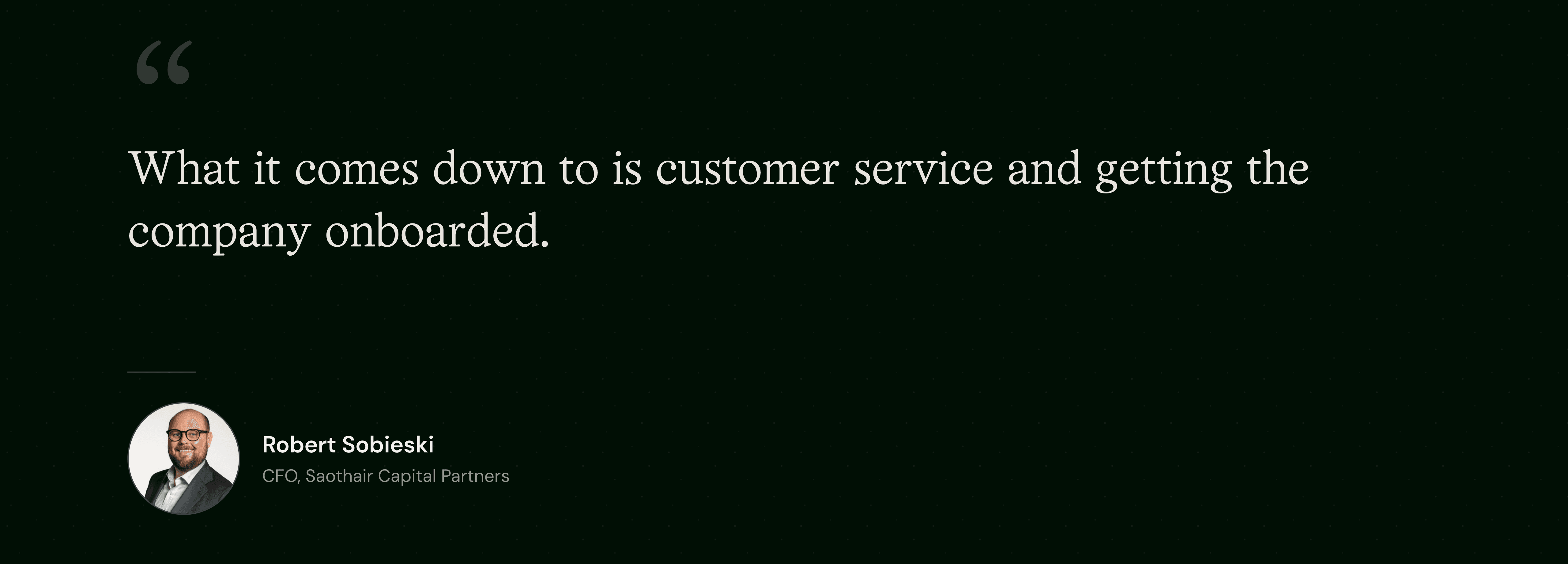
Robert was candid that the platforms were close on features. What separated them was what happened after contract signature. Lumonic delivered on a weekly onboarding cadence, real responsiveness, and follow-through on every commitment. For a first CFO with a January deadline, that mattered more than any feature checklist.
The impact
From Word docs to a weekly operating cadence
The most visible shift is rhythm. Saothair now runs its monthly portfolio reviews directly off the Lumonic platform. Instead of assembling spreadsheets before each session, the team pulls up live dashboards covering financial performance and company-specific KPIs, such as overtime hours, backlog, headcount, and liquidity. The monthly meeting became a conversation about trends and decisions, not a data-assembly exercise.
Valuations integrated with comps
The year-end valuation cycle, which used to live in a separate manual workflow, now runs directly inside Lumonic. Once the quarterly financial review is validated, the same data flows into the valuation templates with PitchBook multiples layered on. Q4 2025 valuations were completed on schedule, with the full process integrated for the first time since the firm's founding.
Data you can defend
Implementation surfaced a number of data integrity issues that had been buried in the prior process. In each case, Lumonic enabled the team to identify the discrepancy and trace numbers back to the source. Issues were resolved during onboarding, and that defensibility is now baseline.
Pre-acquisition financials used to sit in separate Excel files, with no clean way to reconcile across time. Saothair now isolates them in a dedicated scenario, separated from post-close actuals but normalized across both. For the first time, the team can see a company's full financial history as a single, continuous view.
Portfolio companies onboarded without friction
Robert's non-negotiable was that the new process could not add burden to portfolio company finance teams. Saothair invited every portfolio company to the platform themselves, and adoption was frictionless, with no template fights or increased reporting cadence.
Branded dashboards and printable reports
The platform was customized to Saothair's brand, with navy as primary, orange and yellow for negative signals, and the firm's logo on every page. PDF exports now support Robert's monthly reviews with Saothair's founders, and printable dashboards are used in monthly portfolio company meetings. What was a basic Word document LP reporting format now has a foundation to scale from.
Scaling with Saothair's growth
Saothair believes their portfolio is on track to more than double. The deliberate pilot approach of starting with a small cohort of companies with cleaner data and scaling from there means the platform is built to absorb new investments without re-implementation. Junior team members became the day-to-day power users, which freed Robert's time for strategy rather than data maintenance.
Results
Metric | Before Lumonic | With Lumonic |
|---|---|---|
Portfolio monitoring infrastructure | Excel based | Full dashboard suite across portfolio |
Valuations | Manual, team-intensive | PitchBook-integrated, auto-updating |
LP reporting | Basic Word document | Branded dashboards, automated snapshots |
Data ingestion | Varied formats, no normalization | Flexible extraction from any format |
IC and annual meeting prep | Manual, late-stage assembly | Continuous |
Monthly portfolio reviews | Process focused | Platform-driven, live dashboards |
What's next
With the monitoring foundation in place, Saothair is exploring how to push the platform earlier and later in the investment lifecycle, from pre-investment comparables and diligence support through to deeper LP reporting automation. The question has shifted from "how do we build this?" to "what else can the data do?"


